If you need a simple way to shade a patio or garden, a 3 × 3 m sail may look like an easy answer. But the AXT SHADE model’s water protection, usable coverage and installation requirements need a closer look. This review separates the seller’s claims from the mixed buyer feedback so you can decide whether it fits your space.
In short: The AXT SHADE sun shade sail is a 3 × 3 m polyester canopy that the seller says blocks up to 95% of UV rays. It has reinforced edges and installation guidance, but the listing warns against heavy rain and the reviews describe mixed water performance. Treat it primarily as a shade sail, not dependable all-weather shelter.
Is the AXT SHADE sun shade sail worth considering?
The quick verdict: It looks like a plausible option if your priority is summer shade and you can install it with suitable anchor points, fittings and a slope. The listing describes a coated polyester fabric, reinforced construction and a claimed 95% UV blockage. Its displayed customer rating is 4.4 out of 5 from 6,888 ratings.
There are important qualifications. This review is based on the supplied product listing and its review summaries, not hands-on testing. The seller itself says not to use the sail in heavy rain, storms or snow. Customers’ water-resistance feedback is also mixed, with some reporting effective rain protection and others describing pooling or leakage.
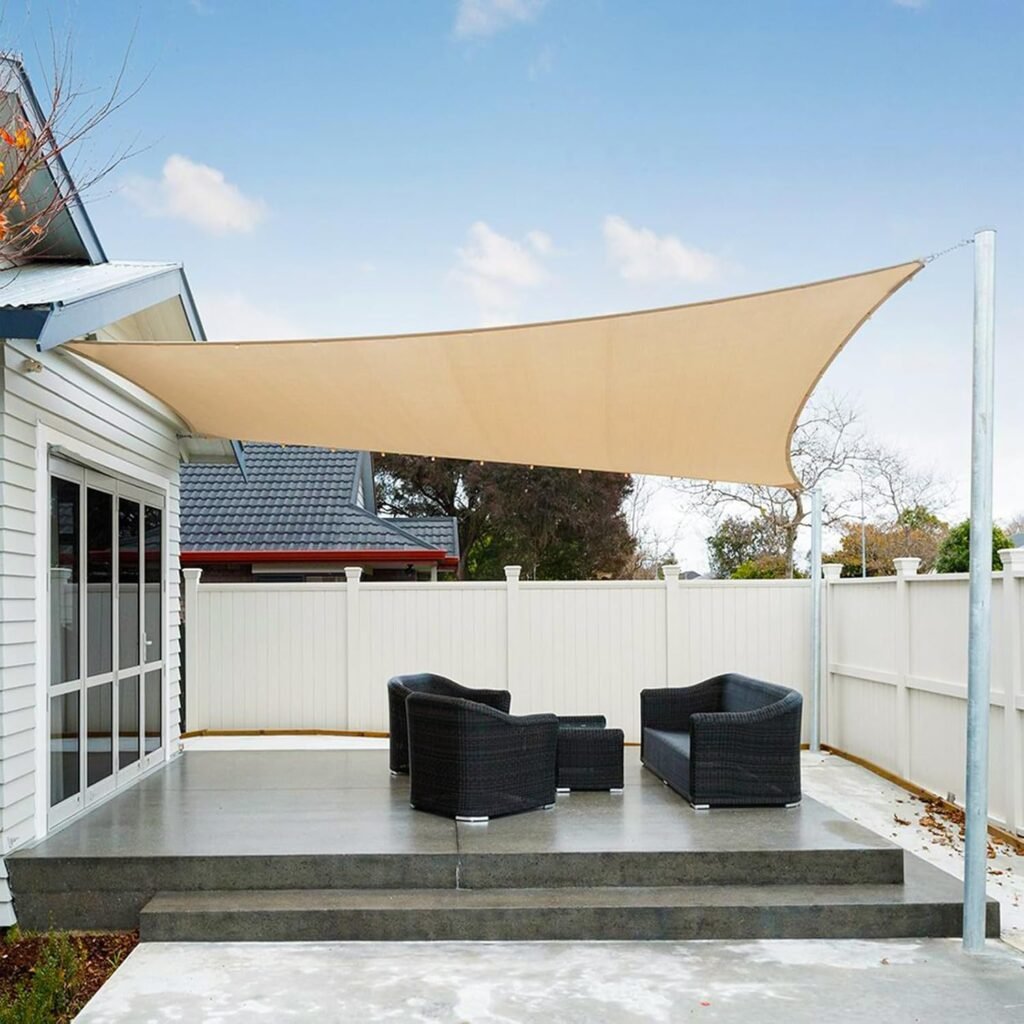
The size also needs interpreting carefully. The nominal measurement is taken from D-ring to D-ring, while the concave edges shorten the sides and reduce the central shaded area. If you need predictable coverage or a canopy to keep furniture dry through prolonged rain, confirm the usable dimensions and consider a product designed and specified for that job.
What is the 3 × 3 m AXT SHADE sail?
This is a square outdoor shade sail in the Sand colour option. The selected listing identifies polyester as its material and gives its weight as 1.64 kg. It is designed to be tied between mounting points, such as suitable trees, poles or fixed structures, rather than standing on its own.
The product description says the fabric has a PU coating. The seller presents that coating as providing water resistance and describes the material as moisture-, mould- and stain-resistant. Those are manufacturer claims rather than results from independent testing in the supplied material.
There is also a specification discrepancy worth checking. One part of the listing describes the fabric as 160 g/㎡ polyester; another states 180 GSM. Those are different fabric-weight figures, and the page does not explain why they differ. Don’t rely on a particular fabric weight unless the seller confirms which figure applies to the size and colour you intend to order.
The page also says the sail is made from two pieces of fabric. It does not explain whether that construction affects the appearance, seam placement or performance of this particular 3 × 3 m Sand version. The seller’s installation instruction is to point the product seam towards the ground.
How much sun protection does it claim to provide?
The seller claims the fabric blocks up to 95% of harmful UV rays and gives it a UPF 50+ rating. That is the main performance claim for buyers seeking shade over a patio, lawn, deck or garden seating area. Customers in the page’s review summary also describe the sail as effective for reducing sun and glare.
That claim should not be mistaken for a promise that the whole space below will be completely protected throughout the day. The actual shade depends on the sun’s angle, the sail’s position, mounting height and the area it covers. The listing itself warns that its concave edges reduce the central shaded area compared with a simple flat measurement.
Colour may also affect the feel of the shade. The product description says lighter colours such as Sand allow more light through, while darker colours provide better shading. That makes Sand a reasonable choice if you prefer a brighter, less enclosed feel, but someone prioritising the deepest shade may want to compare the darker colour options.
A shade sail does not make outdoor sun exposure risk-free. If you are relying on the canopy for sun protection, consider where the sun will fall over the day and use other appropriate sun-protection measures as needed. The listing’s 95% figure is a seller claim, not a result independently tested in this review.
How durable is its construction?
The listed features include a concave edge design, a 304 stainless-steel D-ring at each corner, heavy-duty webbing in the seams and double-thickness reinforced stitching around the edges. These details are intended to support stretching and reduce fraying or deformation, according to the seller.
The page displays 4.4 out of 5 stars from 6,888 ratings. Its review summary describes positive feedback on durability, with customers mentioning strength and long-term use. But individual experiences vary, and the supplied page also includes mixed comments about material quality. A high overall rating is useful context, not a guarantee that every sail will last equally long.
The listing describes the material as 160 g/㎡ in one section and 180 GSM in another. Until that discrepancy is clarified, it is difficult to make a confident assessment of fabric weight against other products. Nor does the provided information give a tested lifespan, wind rating or warranty for the selected sail.
For durability in practice, installation and exposure matter too. The seller advises against storms, thunderstorms, heavy rain and snow. A sail left exposed to unsuitable weather or attached to inadequate fixing points may face conditions the listing does not recommend. If you need a canopy for year-round or severe-weather use, this product page does not establish that it is suitable.
How do you install the AXT SHADE sail?
Plan the mounting points before ordering. The seller says the measurement is taken from D-ring to D-ring and recommends leaving 15–30 cm between the fixing point and the sail for rope or hardware. That extra distance is needed for the connections; measuring only the space you want covered can leave too little room to tension the sail.
The listed installation guidance also says to mount the sail at an angle of 20–40 degrees and orient the seam towards the ground. A slope is intended to help water drain rather than sit on the fabric. The page does not specify which corner should be highest, so plan a practical fall for your particular layout and avoid assuming the sail will drain well if installed flat.
The product has a D-ring at each corner, but the page does not clearly establish which mounting hardware is included with this exact option. Its product description lists four pieces of rope for square or rectangular sails. Ropes are not the same as a full fixing kit: you may still need suitable anchors, attachment hardware or tensioning components, depending on your site. Confirm the package contents before you buy.
The source includes a review from a customer who wished a turnbuckle kit had been included, and another who said they needed additional fittings. That does not prove every package arrives without all required parts, but it reinforces the value of checking what is in the box rather than assuming the sail is ready to mount.
Is the 3 × 3 m size right for your space?
A 3 × 3 m square may suit a compact seating area, but the nominal measurement is not the same as a promise of 9 square metres of flat, uniformly shaded coverage. The seller says measurements are taken from D-ring to D-ring. It also says that the concave design shortens all four sides and makes the central shaded area smaller.
The page gives a possible sizing example: if an installation area measures 3.3 × 4.3 m, select a 3 × 4 m sail, while leaving a 15–30 cm fitting gap between the sail and the fixing points. Use that as the seller’s guidance, not as a substitute for measuring your own anchor locations and checking the sail’s exact shape.
The seller notes that the fabric is cut and sewn by hand and gives a possible size error of 1–10 cm. That range can matter when your fixing points are already in place or when a tight fit is essential. Measure from the actual points where the corner rings will sit, then allow room for the connectors.
Before choosing this square version, sketch the space and the mounting points. Check whether a square shape covers the area you care about, whether there is enough room for fittings and whether the planned slope is possible. If you need to cover a long, narrow table or walkway, the page lists rectangular sizes too, though it does not provide independently measured coverage for them.
Is the sail waterproof in real use?
The answer is not straightforward. The product title and description use the word “waterproof”, and the seller says the PU-coated fabric is waterproof. However, the same product material says not to use it in heavy rain, storms or snowy conditions. The product information also labels its water resistance level as “Water Resistant.”
Customer feedback in the supplied page is mixed. Some reviewers say the sail kept rain off or performed well in wet conditions. Others describe water collecting in the centre, stretching when wet or rain passing through. Those reports are individual experiences, not controlled tests, but they show why the product’s rain performance should not be assumed.
The installation slope is especially relevant. The seller recommends an angle of 20–40 degrees to help water drain. Even with a slope, the page’s review summaries include reports of pooling, so the installation guidance cannot be treated as a guarantee of trouble-free drainage. A sagging centre can collect water, which may put additional strain on the fabric and attachment points.
For a dependable rain shelter, the safest reading of the listing is to treat the sail as a shade product with some water resistance, not as a substitute for a purpose-built roof or all-weather canopy. The seller’s severe-weather warning matters more than the unqualified “waterproof” wording in the title.
How should you clean and care for it?
The seller advises against machine washing the sail. Its care guidance is to rinse it with a hose, or use warm water and mild detergent, keeping the water temperature at or below 30°C. Follow those instructions rather than using a hot wash or assuming the material can go in a washing machine.
The product page describes the fabric as stain-resistant and moisture-resistant, but those claims do not mean it needs no care. If the sail gets dirty, gentle rinsing is the method the seller specifies. Let it dry before storing it, as a sensible way to avoid putting away damp outdoor fabric.
The source does not give a full seasonal storage procedure or instructions for repairing a tear. It also advises against use in thunderstorms, heavy rain, storms and snowy conditions. If the weather exceeds those limits, follow the seller’s warning and take the sail down where practical rather than treating the water-resistant coating as severe-weather protection.
How much does the AXT SHADE sail cost?
The supplied page view does not show a featured offer for the selected 3 × 3 m Sand option. It displays “No featured offers available” and indicates that the item cannot be dispatched to the delivery location selected in that page view. Those details mean a current price or shipping promise cannot be stated from the information provided.
Prices shown for other sizes, colours or similar products on the page should not be treated as the price of this exact variant. They may refer to a different option, seller or delivery arrangement. Check the current product selection, package contents, shipping and returns information before comparing the cost with another sail.
When assessing value, include any fittings you need to buy separately. The product description lists ropes for square and rectangular versions, but the supplied information does not clearly confirm a complete fixing kit for this exact option. A lower sail price may not represent the total installed cost if you also need suitable anchors or tensioning hardware.
Who is this shade sail best suited to?
It may suit you if you want a square fabric canopy for seasonal shade and have appropriate mounting points already available. The listed use cases include patios, lawns, gardens, backyards, pools, decks, courtyards, parks and carports. The claimed UV blockage and Sand colour may appeal if you want a lighter-toned covering that still reduces direct sun.
It is a less convincing choice if your priority is dependable shelter during heavy rain or storms. The seller explicitly warns against those conditions, and customer feedback describes mixed results with rain and pooling. If keeping a particular area dry is essential, compare products with clearly specified drainage and weather ratings rather than relying on the title alone.
It may also be unsuitable if your mounting space leaves little room for fittings. The suggested 15–30 cm gap and the possible 1–10 cm size deviation make careful measurement important. Check the shape, corner positions, anchors and package contents before ordering, especially if the fixing points cannot be moved later.
What alternatives should you compare it with?
The supplied page shows several similar shade sails, but it does not provide a like-for-like independent test. One listing is for a VOUNOT rectangular 3 × 2.5 m sail advertised with 95% UV blockage, breathable HDPE fabric and a fixing kit. Another is a Mokani 3 × 3 m rectangular sail advertised with 95% UV blockage. A RICHIE square option is advertised with 98% UV blockage.
Those details come from the alternative product titles and summaries shown on the page. They do not establish that those products outperform the AXT SHADE sail. In particular, advertised UV figures alone do not tell you how the materials, usable shade, fittings or rain handling compare in real conditions.
Compare the dimensions and shape first. Then check the material, method of measuring the sail, package contents, weather limitations, installation requirements and current price for each exact option. If rain protection matters, look for clear product-specific guidance on slope and drainage, and weigh that against the AXT SHADE seller’s warning not to use this model in heavy rain.
What does this review actually verify?
This review uses the product facts and customer-feedback summaries included in the supplied listing. It does not report a personal installation, laboratory UV test, fabric-weight measurement or rain test. The 95% UV blockage, UPF 50+, construction benefits and water-resistance descriptions are seller claims unless stated otherwise.
The supplied page displays 4.4 out of 5 stars from 6,888 ratings. It also summarizes feedback as generally favourable on sun protection, value, appearance, functionality and durability, with divided opinions on water resistance and material. That gives prospective buyers a broad overview, but it does not show that every review concerns the same size or colour.
One detail particularly needs confirmation before purchase: the fabric weight is given as both 160 g/㎡ and 180 GSM in different parts of the listing. The exact fixing kit contents and the current price for the 3 × 3 m Sand variant are also not established by the supplied information.
Frequently asked questions
Does the AXT SHADE 3 × 3 m sail block 95% of UV rays?
The seller claims that the sail blocks up to 95% of harmful UV rays and gives it a UPF 50+ rating. The supplied information does not include independent test results. Actual shade also depends on positioning, sun angle and coverage, so treat the figure as a product claim rather than a guarantee for every point beneath it.
Can you leave this sail up in heavy rain?
The seller says not to use it in heavy rain, thunderstorms, storms or snow, despite describing the coated fabric as waterproof. Customer feedback on rain performance is mixed, including reports of pooling. If heavy-rain protection is essential, this listing does not establish that the sail is suitable for that purpose.
Does the square sail include a fixing kit?
The product description lists four pieces of rope for square or rectangular sails, but the supplied page does not clearly confirm a complete fixing kit for the selected 3 × 3 m Sand version. Check the exact package contents before ordering, and allow for anchors or tensioning hardware if your installation needs them.
How much space should you leave around the sail?
The seller recommends leaving 15–30 cm between the sail and each fixing point for rope or hardware. It also says the measurements run from D-ring to D-ring. Measure your actual mounting points and account for the fittings, rather than assuming the nominal sail dimensions will fill the entire available gap.
How should you wash the shade sail?
The seller says not to machine wash it. It recommends rinsing with a hose or cleaning with warm water and mild detergent, with the water temperature no higher than 30°C. The supplied information does not give detailed repair instructions or a complete seasonal storage procedure.
What to check before you order
Measure the intended mounting points, allow for the recommended fitting gap and decide whether the concave shape will shade the area you care about. Then confirm the current price, delivery, exact accessories and fabric-weight specification for the 3 × 3 m Sand version before buying.